Visit this page on a laptop to play the demo!
Sound on! This game includes music
Visit this page on a laptop to play the demo!
Sound on! This game includes music
My plan was to "follow the fun" and let the game develop itself where possible, but this created some problems. While this style of developing allowed me to iterate quickly and git rid of mechanics that did not serve the game, I felt stuck
when it came to managing the resource sinks/facets. I waited too long to flesh out the economy. Economy is incredibly important!
Game Maker's Toolkit and every other video essay warned me about scope-creep, but I still succumbed. Developing this greatly increased my sense of how long
implementing mechanics takes. Now, I'm much more confident in my abilites to estimate build times and stay curious while managing scope.
Lastly, I enhanced my understanding of maintainability and data structures. Having a different object for each fish worked fine, but once I added more fish types, the logic became convoluted.
Fortunatley, I was able to learn from my mistakes and consolidated all fish types into one object for the pinball minigame which made coding for that section a breeze.
A couple things I think went well: I was able to utilize playtesting to its fullest extent. After seeing people struggle with my UI, I rearranged things to be more intuitive and
consistent with the design language. I also took feedback on the way players learned. I implemented "tutorials" that greatly improved player's knowledge. However, next time, this will be more integrated than a wall of text.
I'm also proud of the fact that I made bug-fixes the highest priority. While sometimes annoying to deal
with, I think this led to a more cohesive game that implies a real sense of quality.
Literally, ASCII is the American Standard Code for Information Interchange. It's used to give each basic character a numerical code that computers can understand. ASCII art is one of my favorite mediums, and it uses ASCII characters in clever ways to create images. It's all about precision, spacing, and imagination. I'm more of a programmer than anything, so I use archive sites like ASCIIart.com to help me bring this old-school art style to life. Shoutout to the OG pioneers like Joan G. Stark!
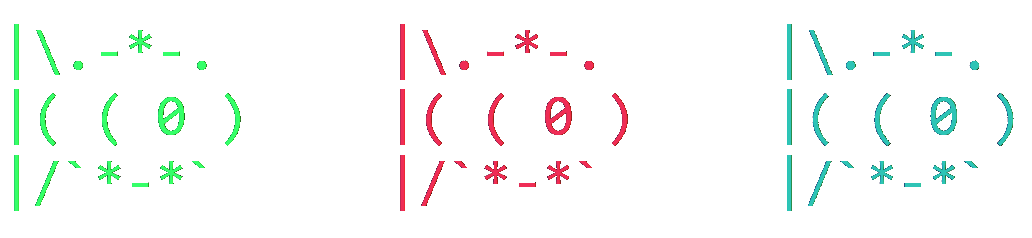
Since the inception of circuit boards and silicon chips, humans have asked the same first question they always do, "huh, I wonder if I can make art using that?" This brings us to the mysterious origins of the first ASCII Aquarium. Some genius along the line figured out they could render images and animations using ASCII characters in computer text terminals. A few bright ideas later, and they had little neon fishies floating around in a dimmly lit virtual world. Once I saw the beautiful and elegant natural diversity of fish mix with the dark-mode vibes of my coding environment, I immediatly wanted to make an aquarium for myself. Why not make it a game and let others do the same? Plus, everyone loves a fishing minigame.
I've been solo developing this game as a side project for a couple months now, and I wanted to give the world a taste. For now, it's going to remain as a fully functional demo on this site, but that doesn't mean I won't come back to it once I've got a fresh outlook and some new ideas. Key inspirations have been video games like Peggle, Pocket Frogs (an old iOS game), and other artists like Daft Punk who have spent decades crafting the perfect vibe I aim to match with this game. A special Thank you to Patrick Jones for doing a wonderful job composing the music!!